Thursday, 25 January 2018

MUSCLE INJURIES

Types of Skeletal Muscle Injuries

Literature study does not reveal great consensus when it comes to classifying muscle injuries, despite their clinical importance. However, the most differentiating factor is the trauma mechanism. Muscle injuries can therefore be broadly classified as either traumatic (acute) or overuse (chronic) injuries.
Acute injuries are usually the result of a single traumatic event and cause a macro-trauma to the muscle. There is an obvious link between the cause and noticeable symptoms. They mostly occur in contact sports such as rugby, soccer and basketball because of their dynamic and high collision nature .
Overuse, chronic or exercise-induced injuries are subtler and usually occur over a longer period of time. They result from repetitive micro-trauma to the muscle. Diagnosing is more challenging since there is a less obvious link between the cause of the injury and the symptoms . 

MUSCLE STRAIN:

A strain to the muscle or muscle tendon is the equivalent of a sprain to ligaments. It is a contraction-induced injury in which muscle fibers tear due to extensive mechanical stress. This mostly occurs as result of a powerful eccentric contraction or overstretching of the muscle. Therefore, it is typical for non contact sports with dynamic character such as sprinting, jumping
Grade I (Mild)
  • Strains affect only a limited number of fibers in the muscle. There is no decrease in strength and there is full active and passive range of motion. Pain and tenderness are often delayed to the next day.
Grade II (Moderate)
  • Strains have nearly half of muscle fibers torn. Acute and significant pain is accompanied by swelling and a minor decrease in muscle strength. Pain is reproduced on muscle contraction.
Grade III (Severe)
  • Strains represent complete rupture of the muscle. This means either the tendon is separated from the muscle belly or the muscle belly is actually torn in 2 parts. Severe swelling and pain and a complete loss of function are characteristic for this type of strain. Th is is seen most frequently at the musculotendinous junction.


MUSCLE CONTUSION:

A bruise, or contusion, is a type of hematoma of tissue in which capillaries and sometimes venules are damaged by trauma, allowing blood to seep, hemorrhage, or extravasate into the surrounding interstitial tissues. Bruises, which do not blanch under pressure, can involve capillaries at the level of skin, subcutaneous tissue, muscle, or bone. As a type of hematoma, a bruise is caused by internal bleeding into the interstitial tissues which does not break through the skin, usually initiated by blunt trauma, which causes damage through physical compression and deceleration forces. Trauma sufficient to cause bruising can occur across a wide range of sports. Bruises often induce pain, but small bruises are not normally dangerous alone. Sometimes bruises can be serious, leading to other more life-threatening forms of hematoma, such as when associated with serious injuries, including fractures and more severe internal bleeding. The likelihood and severity of bruising depends on many factors, including type and healthiness of affected tissues.

Muscle Cramp

Sudden, involuntary muscle contraction or over-shortening; while generally temporary and non-damaging, they can cause mild-to-excruciating pain, and a paralysis-like immobility of the affected muscle(s). Onset is usually sudden, and it resolves on its own over a period of several seconds, minutes, or hours. Cramps may occur in a skeletal muscle or smooth muscle. Skeletal muscle cramps may be caused by muscle fatigue or a lack of electrolytes (e.g., low sodium, low potassium, or low magnesium).

Muscle cramps during exercise are very common, even in elite athletes. Muscles that cramp the most often are the calves, thighs, and arches of the foot. Such cramping is associated with strenuous physical activity and can be intensely painful; however, they can even occur while inactive/relaxed. Around 40% of people who experience skeletal cramps are likely to endure extreme muscle pain, and may be unable to use the entire limb that contains the "locked-up" muscle group. It may take up to seven days for the muscle to return to a pain-free state.
According to Brukner & Kahn  disturbances at various levels of the central and peripheral nervous system and skeletal muscle are involved in the mechanism of cramp and may explain the diverse range of conditions in which cramp occurs. Other popular theories as to the cause of cramps include dehydration, low potassium or low sodium levels, inadequate carbohydrate intake or excessively tight muscles but these hypotheses appear to be falling out of favor as the weight of evidence supports the ‘neural excitability’ hypothesis.

Types of Skeletal Muscle Injuries

Literature study does not reveal great consensus when it comes to classifying muscle injuries, despite their clinical importance. However, the most differentiating factor is the trauma mechanism. Muscle injuries can therefore be broadly classified as either traumatic (acute) or overuse (chronic) injuries.
Acute injuries are usually the result of a single traumatic event and cause a macro-trauma to the muscle. There is an obvious link between the cause and noticeable symptoms. They mostly occur in contact sports such as rugby, soccer and basketball because of their dynamic and high collision nature .
Overuse, chronic or exercise-induced injuries are subtler and usually occur over a longer period of time. They result from repetitive micro-trauma to the muscle. Diagnosing is more challenging since there is a less obvious link between the cause of the injury and the symptoms . 

MUSCLE STRAIN:

A strain to the muscle or muscle tendon is the equivalent of a sprain to ligaments. It is a contraction-induced injury in which muscle fibers tear due to extensive mechanical stress. This mostly occurs as result of a powerful eccentric contraction or overstretching of the muscle. Therefore, it is typical for non contact sports with dynamic character such as sprinting, jumping
Grade I (Mild)
  • Strains affect only a limited number of fibers in the muscle. There is no decrease in strength and there is full active and passive range of motion. Pain and tenderness are often delayed to the next day.
Grade II (Moderate)
  • Strains have nearly half of muscle fibers torn. Acute and significant pain is accompanied by swelling and a minor decrease in muscle strength. Pain is reproduced on muscle contraction.
Grade III (Severe)
  • Strains represent complete rupture of the muscle. This means either the tendon is separated from the muscle belly or the muscle belly is actually torn in 2 parts. Severe swelling and pain and a complete loss of function are characteristic for this type of strain. Th is is seen most frequently at the musculotendinous junction.


MUSCLE CONTUSION:

A bruise, or contusion, is a type of hematoma of tissue in which capillaries and sometimes venules are damaged by trauma, allowing blood to seep, hemorrhage, or extravasate into the surrounding interstitial tissues. Bruises, which do not blanch under pressure, can involve capillaries at the level of skin, subcutaneous tissue, muscle, or bone. As a type of hematoma, a bruise is caused by internal bleeding into the interstitial tissues which does not break through the skin, usually initiated by blunt trauma, which causes damage through physical compression and deceleration forces. Trauma sufficient to cause bruising can occur across a wide range of sports. Bruises often induce pain, but small bruises are not normally dangerous alone. Sometimes bruises can be serious, leading to other more life-threatening forms of hematoma, such as when associated with serious injuries, including fractures and more severe internal bleeding. The likelihood and severity of bruising depends on many factors, including type and healthiness of affected tissues.

Muscle Cramp

Sudden, involuntary muscle contraction or over-shortening; while generally temporary and non-damaging, they can cause mild-to-excruciating pain, and a paralysis-like immobility of the affected muscle(s). Onset is usually sudden, and it resolves on its own over a period of several seconds, minutes, or hours. Cramps may occur in a skeletal muscle or smooth muscle. Skeletal muscle cramps may be caused by muscle fatigue or a lack of electrolytes (e.g., low sodium, low potassium, or low magnesium).

Muscle cramps during exercise are very common, even in elite athletes. Muscles that cramp the most often are the calves, thighs, and arches of the foot. Such cramping is associated with strenuous physical activity and can be intensely painful; however, they can even occur while inactive/relaxed. Around 40% of people who experience skeletal cramps are likely to endure extreme muscle pain, and may be unable to use the entire limb that contains the "locked-up" muscle group. It may take up to seven days for the muscle to return to a pain-free state.
According to Brukner & Kahn  disturbances at various levels of the central and peripheral nervous system and skeletal muscle are involved in the mechanism of cramp and may explain the diverse range of conditions in which cramp occurs. Other popular theories as to the cause of cramps include dehydration, low potassium or low sodium levels, inadequate carbohydrate intake or excessively tight muscles but these hypotheses appear to be falling out of favor as the weight of evidence supports the ‘neural excitability’ hypothesis.

Monday, 22 January 2018

AQUATHERAPY- PLAYS A VITAL ROLE IN REHABILITATION

What is aquatherapy:

Aquatherapy is any activity performed in water to assist in rehabilitation and recovery from hard training or serious injury. 


In modern world of physiotherapy, Aquatherapy is playing a vital role to rehabilitate all patients. from paediatric to neurological, orthopaedical patients. lot and lot of advantages is there, while doing these therapy, there is less energy is used to do those activities, because water is assisting by its property of buoyancy.


Physical properties of water:

In common with other forms of matter, water has certain physical properties which include mass, weight, density, relative density, buoyancy, Hydrostatic pressure, surface tension, refraction and reflection. Of the physical laws of water that the physiotherapist should understand and apply when giving Aquatherapy, those of buoyancy and hydrostatic pressure are the most important. The lateral pressure exerted and the effect of buoyancy together will give the feeling of weightlessness.

1. Buoyancy:

Buoyancy is the force experienced as an upthrust which acts in the opposite direction to the force of gravity. A body in water is therefore subjected to two opposing forces. When the weight of the floating body equals the weight of the liquid displaced, and the centres of buoyancy and gravity are in the same vertical line, the body is kept in stable equilibrium. If the centres are not in the same vertical line the two forces acting on the body will cause it to roll over until it reaches a position of stable equilibrium.

2. Hydrostatic pressure:


The molecules of a fluid thrust upon each part of the surface area of an immersed body. Pascal's law states that fluid pressure is exerted equally on all surface areas of an immersed body at rest at a given depth. Pressure increased with the density of the fluid and with its dept. This means that swelling will be reduced more easily if exercises are given well below the surface of the water where the increased pressure may be used.

Physiological effects of Aquatherapy:

The physiological effects of water therapy combine those brought by the hot water of the pool with those of the exercises. The extent of the effects varies with the temperature of the water, the length of the treatment and the type and severity of the exercise.
The physiological effects of exercise in water are similar to those of exercise on dry land. The blood supply to the working muscles is increased, heat is evolved with each chemical change occurring during the contraction, and the muscles temperature rises. There is an increased metabolism in the muscles resulting in a greater demand for oxygen and increased production of carbon dioxide. These changes augment the similar changes brought about by the heat of the water, and both contribute towards the final effect. The range of joint movement is either maintained or increased, and muscle power increases.
During the immersion the physiological effects are similar to those brought about by any other form of heat but less localized. A rise in body temperature is inevitable because the body gains heat from the water and from all the contracting muscles performing the exercises. As the skin becomes heated the superficial blood vessels dilate and the peripheral blood supply is increased. The blood flowing through these vessels is heated and by convection, the temperature of the underlying structures rises.

The relatively mild heat of the water reduces the sensitivity of sensory nerve endings and the muscle tone will diminish when the muscles are warmed by the blood passing through them.

Therapeutic effects:

  • Relieve pain and muscle spasm
  • To gain relaxation 
  • To maintain or increase the range of joint movement
  • To re-educate paralyzed muscles
  • To strengthen weak muscles and to develop their power and endurance.
  • To encourage walking and other functional and recreational activities.
  • To improve circulation ( trophic condition of the skin ) 
  • To give the patient encouragement and confidence in carrying out his exercises, thereby improving his morale.

Tuesday, 9 January 2018

REHABILITATIVE EXERCISES FOR BICEPS TENDINITIS

Biceps tendinitis is inflammation of the tendon around the long head of the biceps muscle. Biceps tendinosis is caused by degeneration of the tendon from athletics requiring overhead motion or from the normal aging process..


You may do these exercises right away. If any exercise increases your pain, stop doing it. Avoid overhead lifting while your tendon is healing. Some of most useful and valuable exercises to get recovery in biceps tendinitis are

  • Active elbow flexion and extension: Gently bring the palm of the hand on your injured side up toward your shoulder, bending your elbow as much as you can. Then straighten your elbow as far as you can. Repeat 15 times. Do 2 sets of 15.


  • Biceps stretch: Stand facing a wall (about 6 inches, or 15 centimeters, away from the wall). Raise your injured arm out to your side and place the thumb side of your hand against the wall (palm down). Keep your arm straight. Rotate your body in the opposite direction of the raised arm until you feel a stretch in your biceps. Hold 15 seconds. Repeat 3 times.
  • Biceps curl: Stand and hold a 5- to 8-pound weight in your hand. If you do not have a weight, use a soup can or hammer. Bend your elbow and bring your hand (palm up) toward your shoulder. Hold 5 seconds. Slowly straighten your arm and return to your starting position. Do 2 sets of 8 to 12.
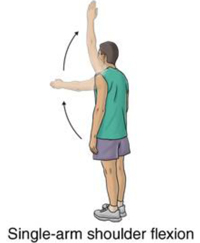
  • Single-arm shoulder flexion: Stand with your injured arm hanging down at your side. Keeping your arm straight, bring your arm forward and up toward the ceiling. Hold this position for 5 seconds. Do 2 sets of 8 to 12. As this exercise becomes easier, add a weight.
  • Resisted shoulder internal rotation: Stand sideways next to a door with your injured arm closest to the door. Tie a knot in the end of the tubing and shut the knot in the door at waist level. Hold the other end of the tubing with the hand of your injured arm. Bend the elbow of your injured arm 90 degrees. Keeping your elbow in at your side, rotate your forearm across your body and then slowly back to the starting position. Make sure you keep your forearm parallel to the floor. Do 2 sets of 8 to 12.
  • Resisted shoulder external rotation: Stand sideways next to a door with your injured arm farther from the door. Tie a knot in the end of the tubing and shut the knot in the door at waist level. Hold the other end of the tubing with the hand of your injured arm. Rest the hand of your injured arm across your stomach. Keeping your elbow in at your side, rotate your arm outward and away from your waist. Slowly return your arm to the starting position. Make sure you keep your elbow bent 90 degrees and your forearm parallel to the floor. Repeat 10 times. Build up to 2 sets of 15.
  • Side-lying external rotation: 
    Lie on your uninjured side with your injured arm at your side and your elbow bent 90 degrees. Keeping your elbow against your side, raise your forearm toward the ceiling and hold for 2 seconds. Slowly lower your arm. Do 2 sets of 15. You can start doing this exercise holding a soup can or light weight and gradually increase the weight as long as there is no pain.
  • Sleeper stretch: 
    Lie on your injured side with your hips and knees flexed and your arm straight out in front of you. Bend the elbow on your injured side to a right angle so that your fingers are pointing toward the ceiling. Then use your other hand to gently push your arm down toward the floor. Keep your shoulder blades lightly squeezed together as you do this exercise. Hold the stretch for 30 seconds. Repeat 3 times.
BICEPS TENDON STRENGTHENING EXERCISES:

Saturday, 6 January 2018

CORE MUSCLE STRENGTHENING FOR ATHLETS

        Core muscle strengthening is a very good activities to improve their fitness for youngsters, Especially for athletic people. Athletic people need very strong core muscle to do their athletic work like running and jumping etc.. 

            Core exercises train the muscles in your pelvis, lower back, hips and abdomen to work in harmony. This leads to better balance and stability, whether on the playing field or in daily activities. In fact, most sports and other physical activities depend on stable core muscles

.            We are going to discuss about those exercises in three posts, including this, and upcoming two posts.


1. Plank to Push-Up
           Get into a standard plank position, contract your core and gluteus and maintain straight back. From the plank position, transition to a push-up position by lifting one forearm off the ground and placing that hand on the ground, followed by the other hand. After you place both hands on the ground in a push-up position, transition back into the original plank position. That is one repetition. 20 repetitions each time, 3 times in a day.

2. Plank Step-Ups
              This one increases strength in both core and triceps muscles, which is ideal for football players. To do this, Get into a standard push up position with a step up board in front of you. While maintaining a tight core and back, lift one hand off the ground onto the board , followed by the other hand. After both hands are on the board, lift the first hand off the board and place it back on the ground followed by the other hand. That is one repetition. You can do 20 repetitions in a time, three times in a day.


3. Alternating Shoulder Tap Plank
            To do this, Get into a standard push-up position. Lift one hand and reach it across your body. Tap your opposite shoulder then place your hand back on the floor. Perform the same motion with the opposite hand. That is one repetition. Do 30 repetitions in each time, 3 times in a day.
4. Barbell Roll-Outs


                     To perform this, Get on your knees with a barbell on the floor in front of you and a 25 pound plate on each side. Grasp the bar with both hands about shoulder width apart. While maintaining a neutral spine, slowly roll the barbell out in front of you are almost parallel to the floor. Using your core, slowly roll the barbell backwards until you return to the starting position. That is one repetition. Do 15 repetition in each time, 3 times in a day.
5. Stability Ball Stir The Pot

                      To do this , get into a standard plank position with your forearms on a stability ball. While maintaining the strong core, use your forearms to rotate the ball in a circular motion until you reach your original starting point. Then rotate the ball in the other direction. that is one repetition. 15 repetitions on each time, 3 times in a day. It is very useful for oblique muscles strengthening

6. Landmine Rotations

                             The Landmine Rotation builds great core strength, primarily in the obliques. To do this, Set up a landmine station by placing one end of a barbell on the ground underneath a heavy dumbbell in a corner. With both hands , lift the opposite end of the barbell and hold it in front of you with your own arms fully extended. Then with your knees slightly bend rotate the bar to one side while maintaining straight arms. Rotate back to the starting position and repeat on the other side. That is one repetition. 10 repetitions on each time, Three times in a day.
7. Stability Ball V-Up Transfers
                   To do this , lie on your back with your arms and legs straight and a stability ball between your legs. Grasp the stability ball with both legs. Simultaneously lift the ball with your legs and lift your arms, forming a " V" shape with your body. Grasp the ball with your hands and simultaneously lower the ball and your legs to the ground without actually touching the ground. Perform the same motion in reverse , transferring the ball from your hands to your legs. That is one repetition, 10 repetitions on each time, 3 times in a day.
8. Lateral V-Ups

                        Lateral V-Ups focus on the oblique muscles. A good variation to normal V-Ups, they require coordination and train your core muscles to activate simultaneously. To do this, lie on your side with one leg on top of the other in a straight line. Place the hand of your bottom arm out in front of you for leverage. Extend your other arm straight over your head. Simultaneously lift both legs and your arm toward each other to form a "V" shape. Slowly lower yourself to the original starting position. That is one repetition. 15 repetitions on each time, 3 times in a day.
9. Weighted Plate Russian Twists

                          The Weighted Plate Russian Twist also focuses on the oblique muscles by requiring rotation. The added weight from the plate requires more muscle activation, building more strength. To do this, sit  on the floor with your legs straight out in front of you. Slightly lean back and lift your legs off the ground. With  a weighted plate in your hands, rotate to one side, then rotate to the other side. That is one repetition. Adjust  the weight based on your level of strength. 15 repetions on each time, 3 times in a day.
10. Crunchy Frogs

                   Crunchy Frogs require you to bring your knees up, crunching your lower abdominal muscles, rather than bringing your head up and crunching your upper abdominal muscles. They also require both legs and the back off the ground, requiring you to balance, which recruits your core stabilizer muscles. To do this, sit on the floor with your legs straight out in front of you. Slightly lean back and lift your legs off the ground. Bend your knees and lift your arms out to the sides about chest high. Simultaneously bring your knees to your chest and your hands forward and toward each other over your knees. Simultaneously  separate your arms and extend your knees to the original starting position. That is one repetition. 30 repetions on each time, 3 times in a day. 

11. Bicycle Crunches

                         This exercise increases strength and endurance, incorporating rotation in the crunch position and targeting the upper abdominal and oblique muscles. To do this, Lie on your back with your hands behind your head and your legs fully extended. Then perform a Crunch, lifting your head off the ground towards your chest and maintaining that position. Simultaneously lift one knee up toward your chest and rotate your upper body so your opposite elbow makes contact with your raised knee. Simultaneously then extend your knee and elbow back to the starting position. without  stopping, repeat with the opposite knee and elbow. That is one repetition. 30 repetitions on each time, 3 times in a day.
12. Sprinter Sit-Ups

                                 As its name indicates, this exercise is most beneficial to track sprinters and athletes in sports requiring explosive speed. To do this exercise, lie on your back with your legs straight and your arms at your sides.Simultaneously sit up and bring one knee up toward your chest. Then extend the arm behind you on the same side as your raised knee. At  the same time, bring your opposite arm forward, bent at a 90-degree angle. After you reach the top of your Sit-Up, lie back down, extend your leg and place both arms back by your sides. Repeat  with the opposite leg. That is one repetition. 15 repetitions in each time, 3 times in a day
13. BOSU Ball Mountain Climbers

                                       How to Perform:Get into a standard push-up position with your hands grasping the side handles of a BOSU ball, flat side up. Maintaining a straight back, bring one knee up to your chest. Extend your knee back to its starting position while simultaneously bringing your opposite knee up to your chest (for a brief moment, both feet are off the ground). That is one repetition. 30 repetitions on each time, 3 times in a day
14. Hanging Straight Leg Raises

                              Probably one of the best tests of a strong core, the Hanging Straight Leg Raise requires great strength in the lower abdominal muscles, hip flexors and lower back.To do this, Hang  from a pull-up bar with an overhand grip, hands about shoulder-width apart. With your legs straight and together, raise them up toward your hands slightly as you lean backwards. Slowly  lower your legs all the way back down to the original starting position. That is one repetition. 10 repetitions on each time, 3 times in a day.
15. Hanging Straight Leg Windshield Wipers

                       These are Hanging Straight Leg Raises with rotation. Adding rotation increases core strength and endurance, specifically the obliques. To do this, Hang from a pull-up bar with a neutral grip. With your legs straight and together, raise them up toward your hands, leaning almost all the way back so you are parallel to the ground. Keeping  your legs straight, slowly rotate to one side, then to the other side. That is one repetition. If this is too difficult, perform the exercise with bent knees. 10 repetitions, 3 sets.

EFFECTIVE CORE MUSCLE STRENGTHENING FROM YOUTUBE :


                      These are the better and beneficial excercises for Athlets and young who wants to be fitness for long time in a short time. Do it undeyour physiotherapists supervision.. Thank you 

Wednesday, 3 January 2018

ILIOTIBIAL BAND SYNDROME AND ITS PHYSIOTHERAPY REHABILITATION


Iliotibial band syndrome is inflammation of the Iliotibial band on the outside of the knee as it rubs against the outside of the knee joint. Symptoms include pain over the outside of the knee which will come on gradually over time getting progressively worse until running must stop. ITBS are most common in athletics mainly runners, So it is also known as (Runner's knee)

Some of the useful preventive excercises are
1. HIP THRUST:
Lie on your back with your arms at your sides, knees bent and your feet on the floor. Pushing your heels into the ground, use your glutes to raise your pelvis up until your body forms a straight line from your knees to your shoulders. Lower slowly, then repeat. For a more advanced version, raise one leg into the air and perform the same exercise with each leg individually. Reps: 20–30 on each side
2. SIDE HIP BRIDGE
Lie on your side with your feet elevated 1–2 feet off the ground on a stable surface. Lift your torso using your hip muscles while keeping your spine stable, then lower slowly. Reps: 10–30 on each side

3. SIDE SHUFFLE
Stand with your legs about hip-width apart with an exercise band around your ankles. Take 10 steps to the right, then 10 back to the left. This is one set. entire movement. Reps: 3–5 sets. To provide resistance you can use thera band too
4. HIP HIKE
Stand on your right foot. Start with your pelvis in a neutral position, and then drop the left side so it is several inches below the right side of your pelvic bone. Use your right hip muscle to lift your left side back to its neutral position. Reps: 10–30 on each side
5. SIDE LEG RAISE
Lie on your right side with both legs straight. Slowly raise your left leg about 45 degrees, then lower. Repeat on both sides. Reps: 20–30 on each side. You can add weight on ankle to get more resistance .
6. CLAM SHELL
Lie on your right side with your knees bent at a 90-degree angle to your torso. Keeping your feet together, use your glutes to slowly open and close your legs like a clamshell.  Use an exercise band just above your knees to increase resistance. Reps: 20–30 on each side

PHYSIOTHERAPY EXERCISE VIDEO: